GROWING UP NEAPOLITAN / JOURNAL
N° 04 — DIASPORA / IDENTITY
PARTENZE: WHY LEAVING NAPLES DOESN'T ALWAYS MEAN LEAVING HOME
NAP → WORLD. More than six million Italian citizens live abroad. Distance changes the relationship with home, but it does not necessarily weaken it.
Published 6 September 2026 · 3 MIN READ
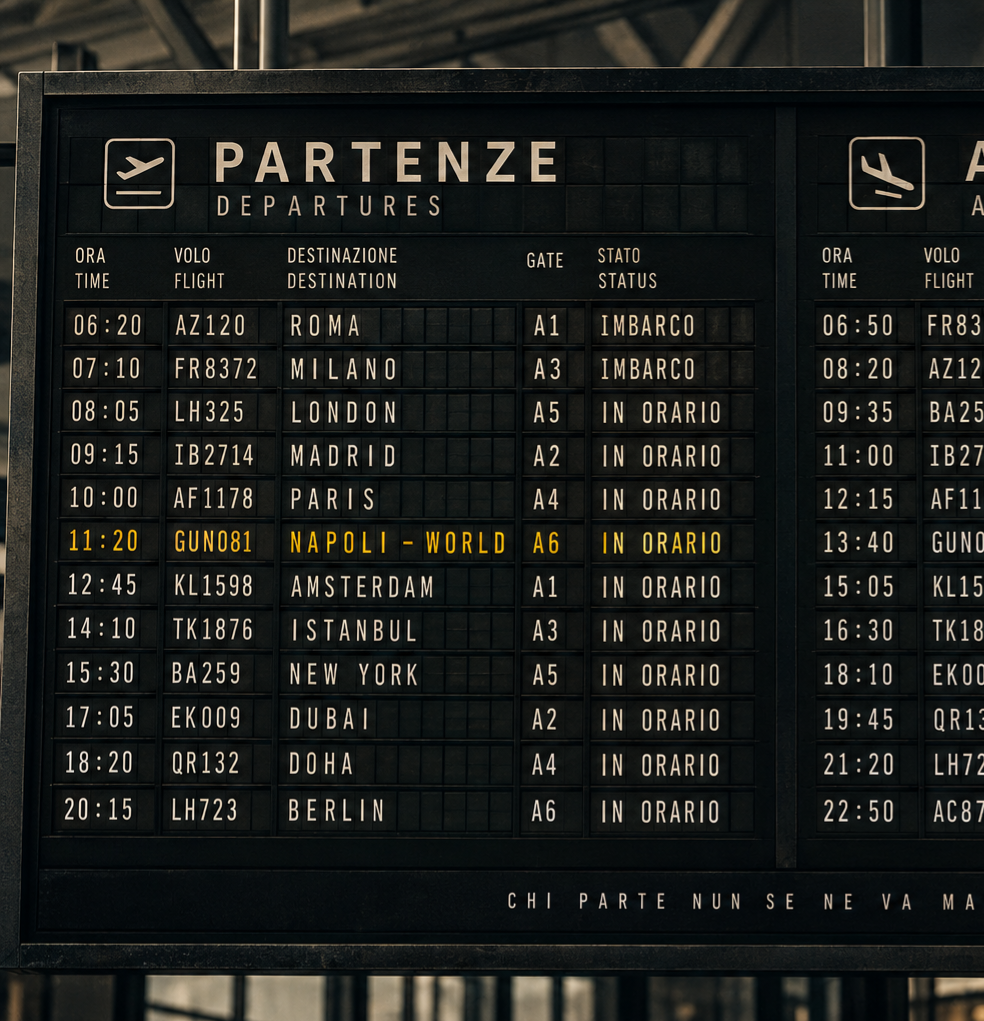
PARTENZE.
Departures.
For generations, leaving has been part of the Italian story.
But migration is not only something that belongs to black-and-white family photographs or stories about ships crossing the Atlantic.
It is happening now.
According to ISTAT's provisional figures published in July 2025, 6.382 million Italian citizens were habitually resident abroad at the end of 2024 — 243,000 more than at the beginning of the year.
ISTAT also estimated around 156,000 expatriations and 53,000 returns of Italian citizens during 2024.
Behind every statistic is a departure.
Why people leave
There is no single reason.
Work.
University.
Love.
Opportunity.
Curiosity.
Ambition.
Sometimes necessity.
Modern mobility is also more complex than the traditional idea of permanent emigration.
People leave.
Some return.
Some leave again.
Some build lives across two countries.
Fondazione Migrantes' Rapporto Italiani nel Mondo continues to describe contemporary Italian mobility as a complex phenomenon made of departures, returns, mobility within Europe and multiple forms of belonging.
The suitcase has changed.
The feeling behind it has not disappeared.
What distance does to identity
Something strange happens when you leave home.
The things you barely noticed become the things you remember most.
A phrase.
An accent.
The noise from the street.
Sunday at your parents' house.
The way someone prepares coffee.
The way your family argues.
The dialect you once used without thinking.
Distance edits memory.
Sometimes it even strengthens identity.
You start explaining things you never had to explain before.
Why your family says a certain phrase.
Why you make a particular gesture.
Why a football result can change the mood of an entire conversation.
Why Naples feels different from simply saying Italy.
Culture does not need a passport to travel. It travels inside people.
The instant recognition of home
Then one day you hear Neapolitan spoken across a room in another country.
You turn around.
Almost automatically.
That moment says something important.
Culture does not need a passport to travel.
It travels inside people.
This is central to the idea behind Growing Up Neapolitan.
Not only people who live in Naples.
People who carry Naples while living somewhere else.
NAP → WORLD
PARTENZE is built around that movement.
NAP → WORLD.
It is not supposed to describe leaving as tragedy.
Nor does it pretend that migration is always romantic.
Leaving can create opportunity.
It can create loneliness.
Freedom.
Distance.
Growth.
Nostalgia.
Sometimes all at once.
But departure does not automatically erase belonging.
A person can build another home without completely losing the first one.
That is the meaning behind the line:
“Chi parte nun se ne va maje.”
Those who leave never completely leave.
Not because they remain physically in Naples.
Because sometimes Naples leaves with them.
Chi parte nun se ne va maje.
SOURCES & REFERENCES
CONTINUE READING
N° 05 — NAPLES TODAY / IDENTITY
NAPLES ISN'T FROZEN IN TIME
The Naples people inherit is never exactly the Naples their parents knew. Identity survives because it moves.
4 MIN READ
READ ARTICLE

N° 01 — HISTORY / FOOTBALL
MARADONA: WHY NAPLES NEVER SAW HIM AS JUST A FOOTBALLER
Football explains the trophies. It does not fully explain why Diego became part of the emotional language of Naples.
3 MIN READ
READ ARTICLE