GROWING UP NEAPOLITAN / JOURNAL
N° 05 — NAPLES TODAY / IDENTITY
NAPLES ISN'T FROZEN IN TIME
The city is changing while its people go global.
The Naples people inherit is never exactly the Naples their parents knew. Identity survives because it moves.
Published 6 September 2026 · 4 MIN READ
There is a version of Naples the world already knows.
Vesuvius.
Maradona.
San Gennaro.
The sea.
The historic centre.
They are real parts of the city.
But they are not the whole city.
Naples today is shaped by people arriving, people leaving, neighbourhoods changing and generations redefining what it means to belong.
A city can protect its identity without pretending time has stopped.
People leave. People arrive.
Migration changes Naples in both directions.
At 1 January 2025, official Italian government integration data recorded 276,531 foreign residents across Campania.
Around half of them — 137,367 people — lived in the province of Naples.
The largest foreign communities in the region included citizens of Ukraine, Romania, Morocco, Bangladesh and Sri Lanka.
These numbers matter because they complicate an old idea of identity.
Naples is not simply sending people into the world.
The world is also becoming part of Naples.
At the same time, Italians continue to move elsewhere in Italy and abroad.
The city is therefore being changed by both departure and arrival.
A city seen from outside
Naples and Campania also have to manage how the territory is experienced by visitors.
In March 2026, Regione Campania announced work to strengthen tourism monitoring and move toward a regional observatory for tourism flows.
The proposed system is intended to analyse arrivals, overnight stays, visitor origins, types of stay and travel patterns more precisely.
That administrative language points to something larger.
Naples is a city experienced not only by the people who grow up there, but by people who encounter it from outside.
And those are two different relationships.
Visiting Naples is not the same as growing up Neapolitan.
A map describes position. It does not describe value.
What you know without being taught
Growing up Neapolitan means absorbing codes.
The way a sentence changes when it is said in dialect.
The joke that does not need explaining.
The family warning that sounds absurd until you hear yourself repeating it years later.
The football references.
The superstition.
The neighbourhood loyalties.
The gestures.
The emotional geography of the city.
Nobody gives you a handbook.
You learn it by living around it.
That is why identity cannot be reduced to landmarks.
Beyond the postcard
Naples is also its edges.
Its residential districts.
Its social housing.
Its streets far from the routes most visitors follow.
Its periferia.
The word describes a position in relation to a centre.
But a map describes position.
It does not describe value.
A neighbourhood can be peripheral geographically and central to the identity of the people who come from it.
That distinction matters.
Too often periferia is discussed only through absence:
what it lacks, what it needs, what is wrong with it.
But people do not experience home only as a list of problems.
They experience friendships.
Family.
Memory.
Language.
Pride.
Contradiction.
Belonging.
PERIFERIA. It's home, it's identity, it's pride.
PERIFERIA.
For Growing Up Neapolitan, PERIFERIA is not an attempt to romanticise inequality or ignore real social problems.
It is about refusing the idea that cultural value exists only in the centre.
A city is not only the part that photographs well.
Its identity is also produced in places the postcard leaves outside the frame.
That is why the phrase matters:
PERIFERIA.
It's home, it's identity, it's pride.
A culture that moves survives
Naples is changing.
Neapolitans are moving through the world.
New people are building lives in Naples.
Neighbourhoods evolve.
Language evolves.
Culture absorbs new influences.
None of that automatically destroys identity.
Culture survives precisely because people continue to use it.
They carry it somewhere new.
They translate it.
They argue about it.
They reinterpret it.
They wear it.
The objective is not to freeze Naples at some imaginary perfect moment in the past.
It is to recognise the things that remain meaningful while the city continues moving.
Growing Up Neapolitan exists inside that movement.
For those who stayed.
For those who left.
For those from the centre.
For those from the periferia.
And for anyone who understands that home is not measured only by distance from a city centre.
Sometimes it is measured by how much of that place you still carry inside you.
SOURCES & REFERENCES
CONTINUE READING
N° 04 — DIASPORA / IDENTITY
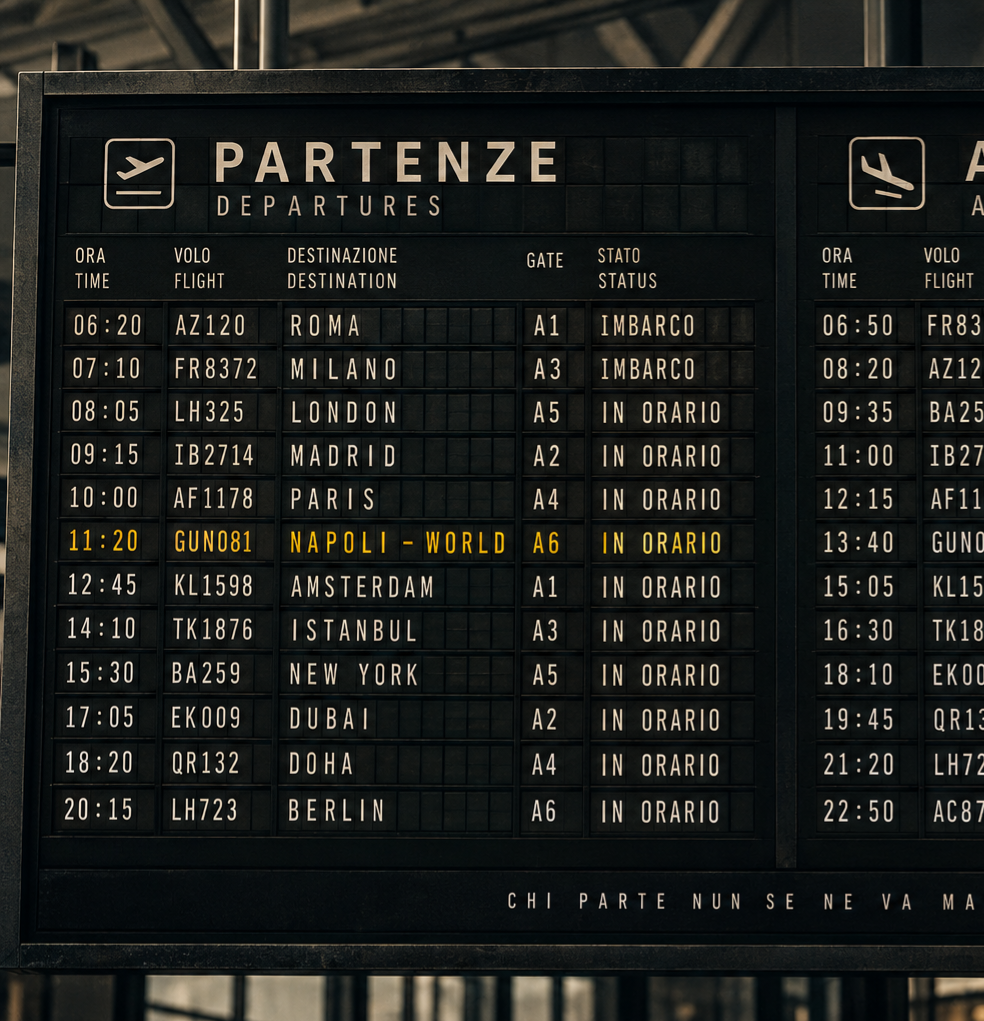
PARTENZE: WHY LEAVING NAPLES DOESN'T ALWAYS MEAN LEAVING HOME
NAP → WORLD. More than six million Italian citizens live abroad. Distance changes the relationship with home, but it does not necessarily weaken it.
3 MIN READ
READ ARTICLE
N° 02 — FOLKLORE / SUPERSTITION
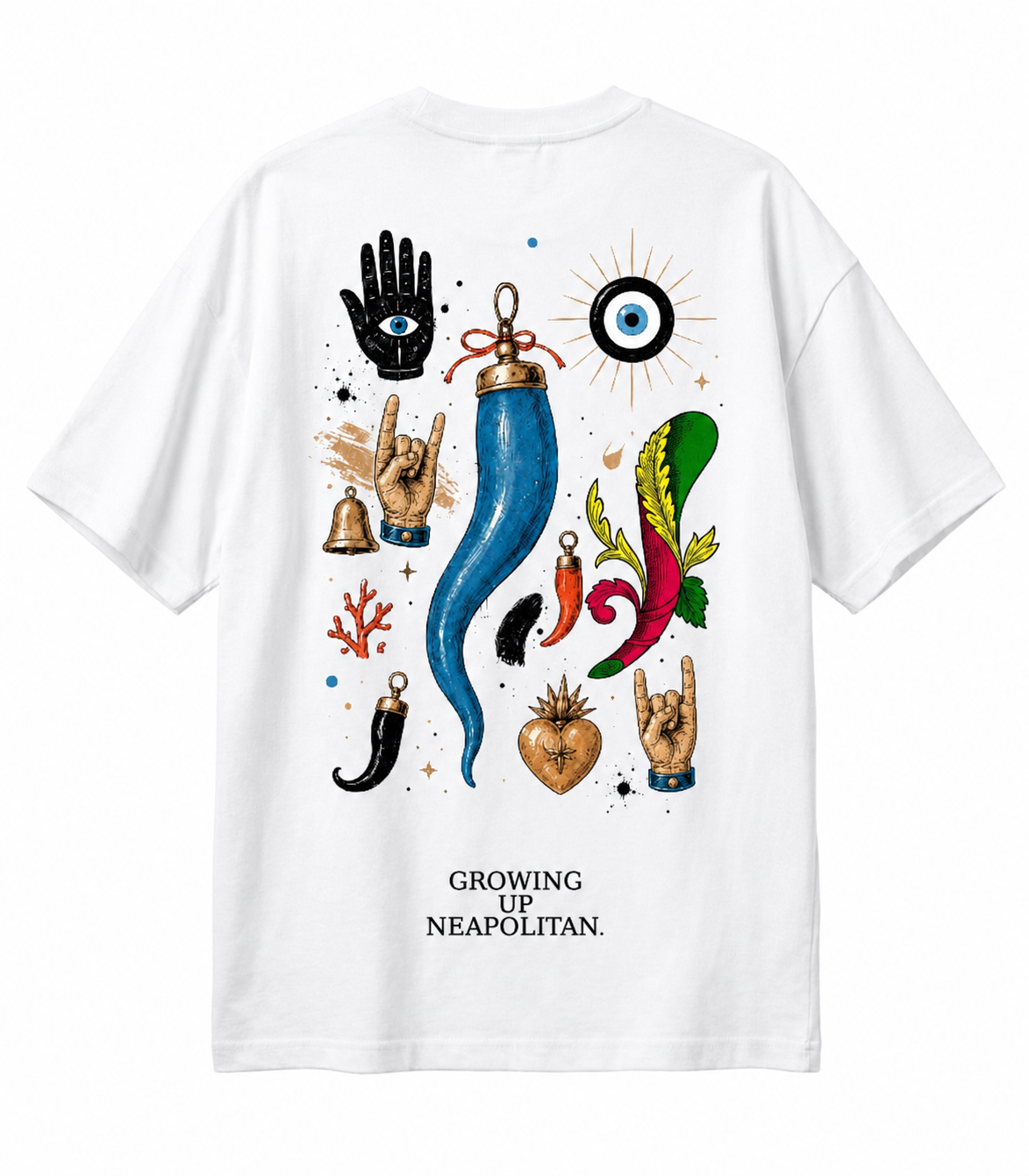
“NON È VERO, MA CI CREDO”: THE EVIL EYE IN NAPLES
You do not have to believe in superstition to grow up speaking its language.
3 MIN READ
READ ARTICLE