GROWING UP NEAPOLITAN / JOURNAL
N° 01 — HISTORY / FOOTBALL
MARADONA: WHY NAPLES NEVER SAW HIM AS JUST A FOOTBALLER
Football explains the trophies. It does not fully explain why Diego became part of the emotional language of Naples.
Published 6 September 2026 · 3 MIN READ
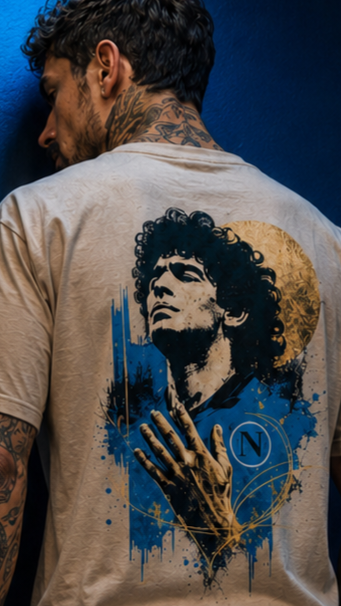
There are footballers. There are champions. And then, in Naples, there is Diego.
Diego Armando Maradona arrived at Napoli in 1984. The club had never won Serie A.
Three seasons later, everything changed.
In 1986–87 Napoli became champions of Italy for the first time. The same season also brought the Coppa Italia. A second league title followed in 1989–90, while in between came Napoli's first major European trophy: the 1988–89 UEFA Cup.
Those facts explain Maradona's importance to the history of SSC Napoli.
They do not completely explain Naples' relationship with him.
A victory that belonged to a city
When Napoli secured its first Scudetto in May 1987, the celebration went far beyond football.
The success mattered because of where it happened.
Italian football had long been dominated by major clubs from the country's wealthier northern cities. Napoli's rise allowed a southern city to challenge that hierarchy on one of Italy's most visible stages.
Maradona stood at the centre of it.
He was the best-known player in the team, but he also carried a story people in Naples recognised: enormous talent emerging from a difficult background, irreverence toward authority, brilliance mixed with vulnerability.
Naples did not need him to be polished.
Perhaps that was part of the connection.
Diego and the city
Maradona's years at Napoli changed the club permanently.
UEFA's retrospective on his European performances describes the 1988–89 UEFA Cup as the only continental club trophy he won. Napoli overcame Juventus and Bayern Munich before defeating Stuttgart 5–4 on aggregate in the final.
Yet if you walk through Naples, those trophies feel like only one part of the story.
Diego appears on shutters, walls, flags, photographs, tattoos and improvised shrines.
His face became part of the city's visual vocabulary.
Football created the story. Naples turned it into folklore.
Sacred and profane
Naples has always lived comfortably with a closeness between the sacred and the everyday.
A religious image can exist a few metres from a football shrine.
A saint, a family photograph and a footballer can all become part of the same neighbourhood landscape.
Maradona entered that language.
This does not mean people literally confused football with religion. It means the city found its own way to express devotion, gratitude, memory and belonging.
Diego became an icon through popular culture.
That is different from simply becoming famous.
Why the relationship remains
Maradona was not loved because he represented perfection.
His life was full of contradictions.
So is Naples.
The connection survived because it was never only about individual goals or statistics. For many supporters, he represented a moment when Naples could look at the rest of Italy and feel that an established football hierarchy had been overturned.
The world's most famous footballer wore Napoli blue.
And Napoli won.
After Maradona's death in 2020, Naples renamed the former Stadio San Paolo in his honour.
The official name only formalised something that had existed emotionally for decades.
The city had already made him its own.
Football created the story.
Naples turned it into folklore.
SOURCES & REFERENCES
CONTINUE READING
N° 03 — FAITH / FOLKLORE
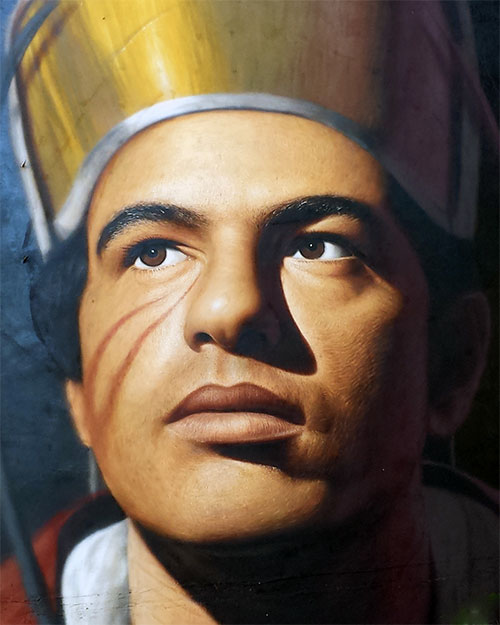
SAN GENNARO: THE SAINT NAPLES TALKS TO LIKE FAMILY
In Naples, devotion is rarely distant. The relationship with San Gennaro is intimate, emotional and deeply woven into city life.
3 MIN READ
READ ARTICLE
N° 05 — NAPLES TODAY / IDENTITY
NAPLES ISN'T FROZEN IN TIME
The Naples people inherit is never exactly the Naples their parents knew. Identity survives because it moves.
4 MIN READ
READ ARTICLE